Visit at IPHC :
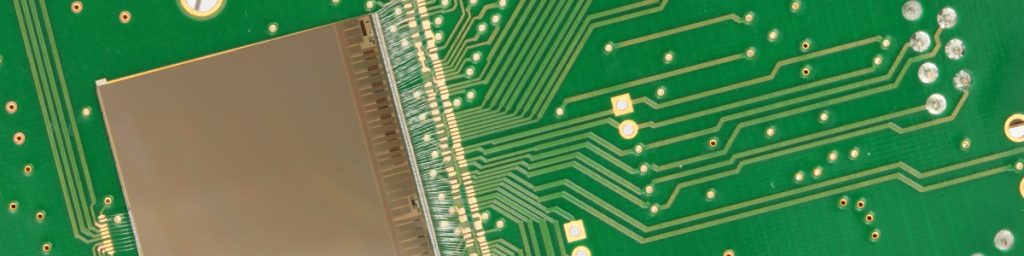
C4PI platform
The Competence Center for CMOS Sensors with Integrated Pixels (C4PI) is a platform composed of around twenty engineers and technicians, and whose main activity is the development of monolithic CMOS sensors with pixels (CPS), from the definition of the specifications and the design to the validation and the construction. The C4PI platform mainly works on medium and long-term projects in partnership with national and international collaborators. Labeled by IN2P3, it consists of two groups:
- Microtechnology, ensuring the integration, metrology and validation of hybrid electronic systems necessary for the development and production of detection elements.
- Microelectronics, specialized in the development of integrated pixel sensors in CMOS technology (or CPS for CMOS Pixel Sensors).
C4PI benefits from cutting-edge expertise in the development of CMOS sensors through innovative R&D carried out for many years at IPHC. Among the many achievements of C4Pi are the world’s first pixel CMOS sensor to have equipped a particle detector with this technology (the PXL of the STAR experiment in the USA), as well as the ultralight double-sided detection module PLUME, with which is built the BEAST detector for the BELLE2 experiment. C4PI was also involved in the design of the ALPIDE sensor and was one of the five construction sites of the resulting detector, the ITS2 of the ALICE experiment. ALPIDE is the current reference of pixel sensors for the detection of charged particles.
In 2020, C4PI has started an ambitious R&D program to create the discipline’s first giant, curved sensors, typically the size of an A4 sheet. This international project at CERN, in which C4PI, the only French group, plays a prominent role, will redefine the state of the art in the field. All the developments cited contribute to prefiguring the first detection layers of future e+e- colliders.
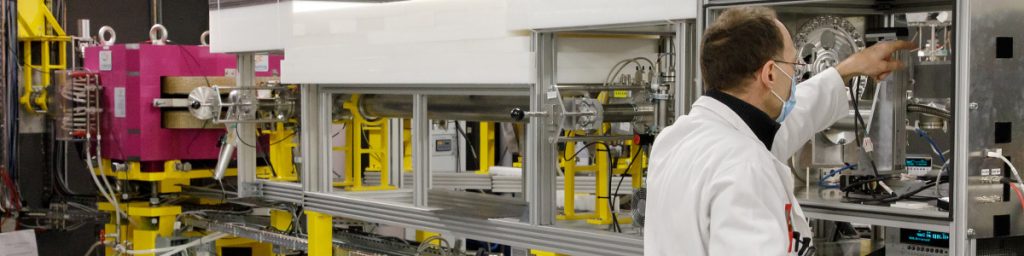
CYRCé platform
CYRCé is a scientific platform managed by a team of eight people. It incorporates a 25 MeV cyclotron with unique characteristics in Europe, making it possible to produce radioisotopes for nuclear imaging (18F, 64Cu, 89Zr, and soon 68Ga and 67Cu) and the production of labeled molecules for diagnosis, monitoring or medical treatment. The cyclotron is coupled to the PRECy experimental radiobiology line and the PET/CT X imaging system, as well as to a sensor test line for CMS (figure 5). The CYRCé platform is a unique place for the study of biological effects and their medium and long-term monitoring. The platform is organized around four main activities:
- The use of protons (for the production of isotopes or sample irradiation)
- The imaging platform
- The animal house
- Biology laboratories
The platform is labeled by IN2P3 and CORTECS, the network of the University of Strasbourg. The imaging platform also has the IBiSA label since 2019.
Website of the Platform: cyrce.fr